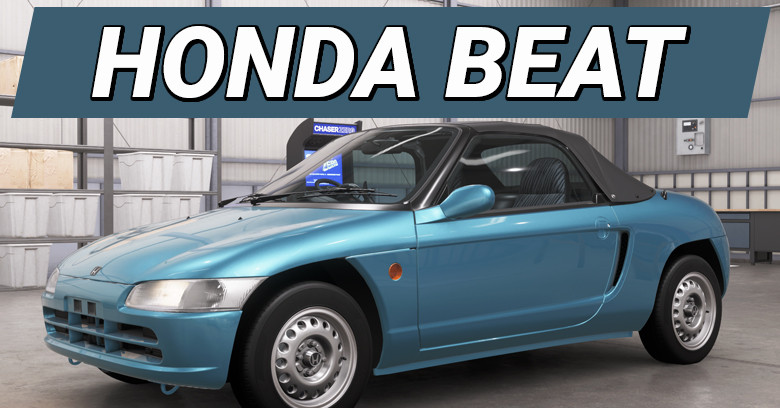
The 1991 Honda Beat is a D class car in Forza Horizon 6. Find this car upgrade list, and tune for circuit and street race down below.
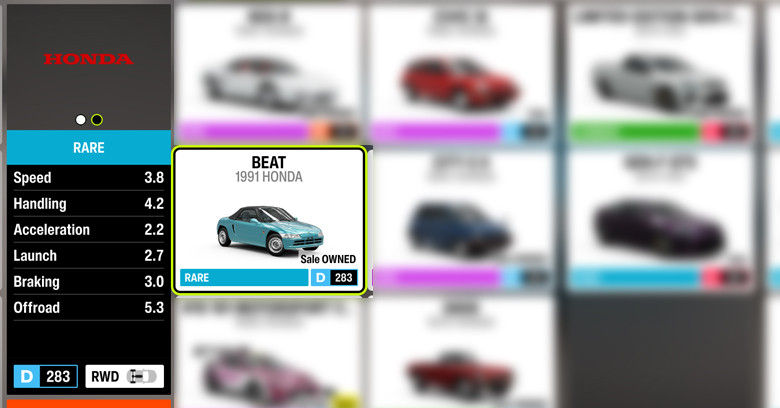
The Honda Beat PI starts at D 283 which allows us very much wiggle room to upgrade it to max D400, we’ve upgraded the engine, handability, and much more to make this RWD mid engine car perform well.
Honda Beat Tune Code in Fh6

If you like our tune and want our exact location, put this code in: Tune Browser > Search > Share Code > and input our share code.
Honda Beat Upgrade List
+Engine:
- Intake: Race
- Oil / Cooling: Race
- Flywheel: Race
+Platform and Handling:
- Brakes: Race
- Spring and Dampers: Race
- Front & Rear Anti-roll Bars: Race
- Weight Reduction: Race
+Drivetrain:
- Clutch: Race
- Transmission: Race
- Driveline: Race
- Differential: Race
+Tires and Rims:
- Rear Tire Width: 195mm
Honda Beat Tune List
Tires
- Front Tire Pressure: 1.9 BAR
- Rear Tire Pressure: 1.9 BAR
Lower tire pressure (approx. 27.5 PSI / 1.9 BAR) gives this lightweight car maximum grip and keeps it glued to the road.
Gearing
- Final Drive: 5.20
- 1st Gear: 3.10
- 2nd Gear: 2.15
- 3rd Gear: 1.65
- 4th Gear: 1.35
- 5th Gear: 1.15
- 6th Gear: 0.98
A short final drive (slid toward Acceleration) keeps the tiny engine revving high, helping this low-power D-class car accelerate much faster.
Alignment
- Camber (Front): -1.5°
- Camber (Rear): -1.1°
- Toe (Front): 0.0°
- Toe (Rear): -0.1°
- Front Caster: 6.0°
Adding a tiny bit of rear toe-in keeps this short, mid-engine car stable and stops the back end from spinning out during sharp turns.
Antiroll Bars
- Front: 12.00
- Rear: 18.00
Softer anti-roll bars keep the car stable over bumps, while a slightly stiffer rear bar helps the car turn into corners more easily.
Springs
- Front Springs: 34.0 KGF/MM
- Rear Springs: 44.0 KGF/MM
- Ride Height (Front): 11.5 CM
- Ride Height (Rear): 12.5 CM
Stiffer rear springs support the heavy back end of the car, while a low ride height stops it from leaning too much during quick S-turns.
Damping
- Rebound Stiffness (Front): 8.5
- Rebound Stiffness (Rear): 9.2
- Bump Stiffness (Front): 4.2
- Bump Stiffness (Rear): 4.6
Stiff front bump stiffness stops the nose from diving under hard braking, keeping the car stable and improving your stopping distance.
Brakes
- Balance: 50%
- Pressure: 100%
A balanced 50% brake bias gives you predictable, even stopping power between the front and rear wheels.
Differential
- Acceleration: 40%
- Deceleration: 15%
Setting acceleration to 40% puts power down smoothly without spinning the tires, while 15% deceleration stops the back end from sliding out when you let off the gas.
Overall, when building this car, we help you maintain speed through corners, prevent the rear end from spinning out, and are easy to control.
Here is our before vs after stats change:
- Weight: 760kg > 629kg
- Peak Power: 45 KW > 55 KW
- PWR: 0.06 KW/kg > 0.09 KW/kg
- Lateral Gs: 1.2 > 1.3
- Performance Class: D 283 > D 400
Other Honda Tune
End of Guide.